



Some marketing myths refuse to die.
They keep showing up in strategy calls, campaign reviews, client reports, and internal marketing meetings. Someone says them with confidence. Everyone nods because they sound familiar. Then the team makes another budget decision based on something that was never fully true in the first place.
That is where campaigns start to go wrong.
Table of Contents
THE WALKING DEAD OF MARKETING
Most of the time, marketing results suffer because teams keep acting on outdated beliefs that feel like common sense.
You have probably heard some of them before.
More traffic will fix the funnel.
Cheap leads mean the campaign is working.
A high click-through rate means the ad is successful.
Google Ads is only for people ready to buy right now.
Meta Ads cannot work for serious B2B companies.
The platform knows best, so we should let automation handle everything.
These ideas are dangerous because they are not always completely false. They are half true, and half-truths are where a lot of wasted ad spend lives.
This article breaks down the myths that quietly damage marketing results, especially when teams are running Meta Ads, Google Ads, or any other paid acquisition channel.
Why do these marketing myths keep coming back?
Marketing myths survive because they are easy to repeat.
They make complicated problems sound simple. If lead volume is low, spend more. If clicks are expensive, find cheaper clicks. If conversions are weak, change the creative. If the platform recommends automation, turn it on.
The problem is that paid marketing rarely fails for one simple reason.
A campaign can have decent ads and still fail because the landing page is weak. A campaign can generate leads and still fail because the leads are not qualified. A campaign can have a good CPL and still fail because nothing turns into a pipeline.
This is why myths are so sticky. They help teams avoid harder questions.
It is easier to say “we need more traffic” than to ask whether the traffic is landing on the right page.
It is easier to celebrate cheap leads than to check whether sales actually want those leads.
It is easier to blame the platform than to inspect the offer, targeting, tracking, and follow-up process.
Good marketing comes from better questions. Bad marketing usually starts when a team stops questioning its assumptions.
Is more traffic really the answer when the campaign is not converting?
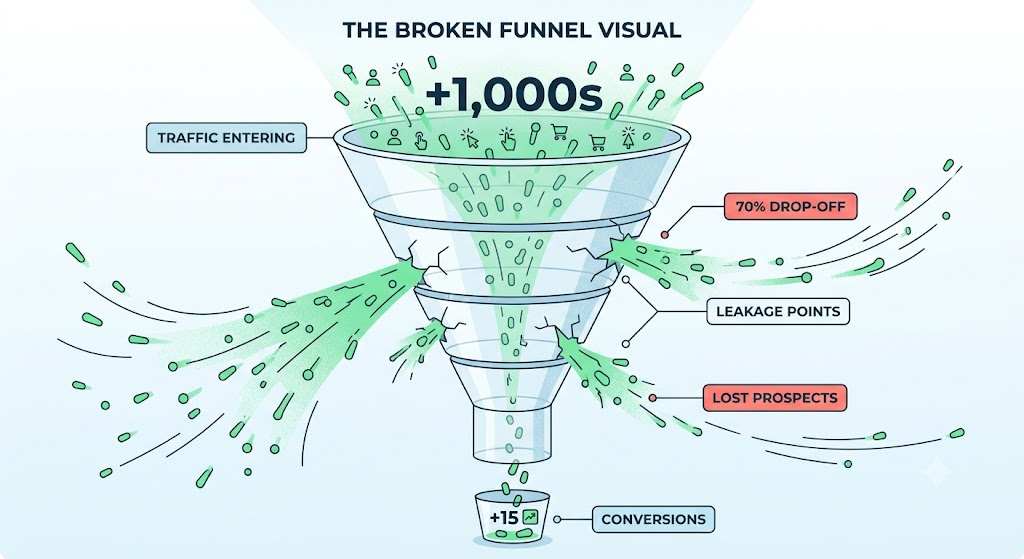
More traffic sounds like progress.
More clicks look good in a report. More visitors make the campaign feel active. More impressions make the brand feel visible.
But traffic does not fix a broken funnel. It only exposes the problem faster.
If the landing page is unclear, more visitors will not solve it. If the offer is weak, more visitors will not suddenly care. If the ad promise does not match the page, more visitors will leave with the same confusion as the visitors before them.
This happens often when paid traffic is sent to a homepage.
A homepage usually has too many jobs. It speaks to prospects, customers, investors, job seekers, partners, and sometimes even the press. Paid traffic needs something much sharper.
It needs one clear audience, one clear problem, one clear promise, and one clear next step.
Before increasing the budget, ask this instead:
Are the right people taking the right action once they arrive?
If the answer is no, traffic is not the bottleneck. The conversion path is.
A campaign does not become better just because more people see it. It becomes better when the right people understand why they should act.
Are cheap leads always better for marketing results?
Cheap leads feel good at first.
They make the CPL look efficient. They make the campaign easier to defend. They create the feeling that marketing is working because there is visible activity.
But cheap leads can quietly damage marketing results if they never become real opportunities.
This is one of the biggest traps in paid acquisition.
A form submission is not always a buyer. A content download is not always a serious prospect. A webinar signup is not always a sales-ready lead.
Soft conversions can be useful, but only when everyone understands what they are for. They can build remarketing audiences, feed nurture sequences, and create early intent signals. They should not automatically be treated like a qualified pipeline.
The problem starts when every conversion is reported as if it has the same value.
A founder booking a demo and a student downloading a guide are not the same thing.
A CFO requesting pricing and a random visitor filling out a broad checklist are not the same thing.
A good report should make those differences clear.
| Metric | What it seems to show | Where it can mislead you | What you should ask instead |
|---|---|---|---|
| Cost per lead | Leads are getting cheaper | Sales may be rejecting most of them | How many leads become qualified opportunities? |
| Click through rate | People are interested | The message may be attracting curiosity, not buyers | Are the right people clicking? |
| Conversion rate | The page is working | The form may be too easy, or the offer may be too broad | Do conversions match our ICP? |
| Cost per demo | Demos are affordable | Demo quality may still be poor | How many demos become pipeline? |
| Platform conversions | The campaign is producing activity | The platform may be optimizing for the wrong event | Are we tracking the outcome that matters? |
Cheap leads are only useful if they move the business closer to revenue.
Otherwise, they are just a cheaper way to create noise.
Does a high click-through rate mean the ad is working?
A high click-through rate means your ad earned attention.
That is useful, but it is not the same as success.
An ad can get clicks because it is clever. It can get clicks because it is vague. It can get clicks because it creates curiosity. It can even get clicks because it slightly overpromises.
None of that means the campaign is attracting the right buyer.
This is where teams often get stuck. The ad looks strong in the platform dashboard, but the sales team says the leads are weak. Marketing sees engagement. Sales sees a poor fit.
Both can be true.
The better question is not “Did people click?”
The better question is “What happened after they clicked?”
Did they stay on the page?
Did they understand the offer?
Did they take the next step?
Did they match the target customer profile?
Did they become a real sales conversation?
The click is not the win. The click is the cost of testing whether your message attracted the right person.
This is why message match matters so much.
If the ad says one thing and the landing page says something broader, weaker, or different, the visitor has to do the work of connecting the dots. Most people will not do that.
They clicked for a specific promise. The landing page needs to continue that promise clearly.
Should you trust the ad platform to optimize everything for you?
Platform automation has improved a lot.
Meta Ads and Google Ads can both find patterns that humans cannot manually spot at scale. Smart bidding and algorithmic delivery can be helpful when the account has enough data and the right signals.
But automation is not a strategy.
The platform will optimize toward the goal you give it. If the goal is wrong, the campaign may become very efficient at producing the wrong result.
If you optimize for cheap form fills, the system will look for people likely to submit forms.
If you optimize for clicks, it will look for people likely to click.
If you optimize for low-quality leads, you may find more low-quality leads.
That does not mean automation is bad. It means automation needs clean inputs.
The real work is deciding what the platform should be learning from.
For a lead generation business, the best signal is usually not just a form fill. It may be a qualified lead, a demo booked, an opportunity created, or a closed deal imported back into the ad platform.
Not every account has enough conversion volume to optimize that deeply from day one. That is fine. The point is to build toward better signals instead of letting the campaign learn from shallow activity forever.
Automation makes strong systems stronger.
It also makes broken systems burn the budget faster.
Is Google Ads only useful when people are ready to buy today?
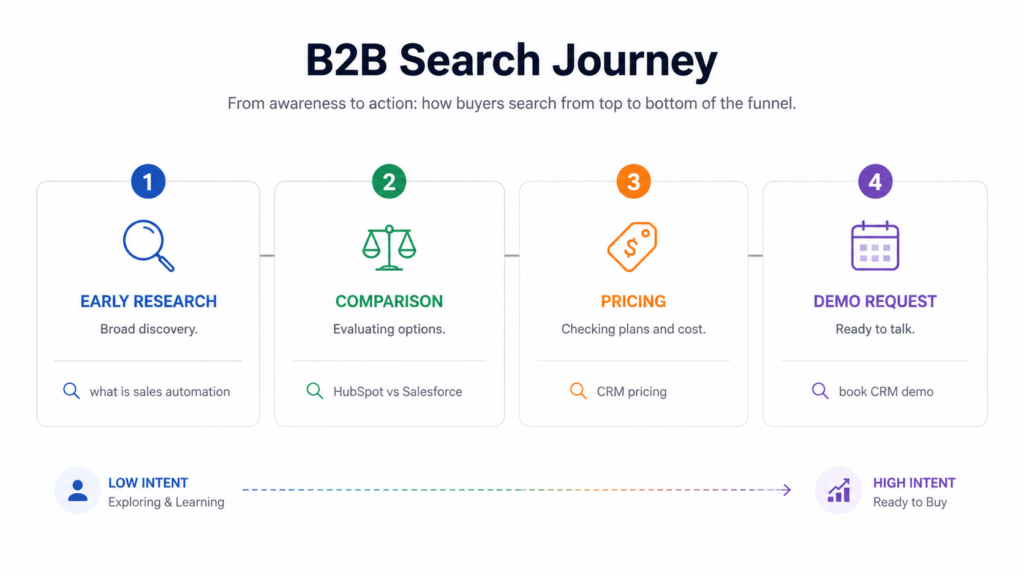
Google Ads is often treated like a pure bottom-of-the-funnel channel.
That makes sense in some cases. Search is powerful because people are actively looking for something. They are not just scrolling. They are typing in a problem, product, service, or competitor.
But the myth is that every valuable searcher is ready to buy today.
Many buyers search long before they speak to sales.
They compare options. They research costs. They look for examples. They search for alternatives. They try to understand the problem before committing to a solution.
If you only chase the most obvious buying keywords, you may end up in the most expensive and competitive part of the market.
A better approach is to separate search intent by stage.
Someone searching “best payroll outsourcing company” is not in the same mindset as someone searching “what is payroll outsourcing.”
Someone searching “Google Ads agency for SaaS” is not in the same mindset as someone searching “how to reduce cost per lead.”
Both may be relevant, but they need different campaigns, different copy, and different landing pages.
The mistake is putting every keyword into the same bucket and expecting the platform to understand the buyer journey on its own.
Search works best when intent is respected.
Can Meta Ads work for B2B, or is that just an e-commerce channel?
B2B teams often dismiss meta Ads.
The argument usually sounds like this: people are not on Facebook or Instagram to buy business software or professional services, so the channel cannot work.
There is some truth in that.
People on Meta usually don't search for solutions the same way they do on Google. They are scrolling, checking updates, watching videos, or passing the time. That means cold audiences may not respond well to aggressive bottom-funnel offers.
But that does not mean the channel cannot support B2B marketing results.
It means the campaign needs to match the temperature of the audience.
A cold audience may not be ready to book a call. They may respond better to a useful guide, a diagnostic checklist, a webinar, a short founder-focused point of view, or a simple problem awareness ad.
Warm audiences may respond to case studies, proof, comparison content, or retargeting that handles objections.
Hot audiences may be ready for the direct offer.
The issue is not that Meta is only for e-commerce. The issue is that many B2B advertisers ask Meta to behave like search.
That is where the mismatch happens.
Meta can create familiarity, educate the market, build remarketing pools, and bring people back when they are warmer. It just should not be judged only by whether cold traffic books demos on the first click.
Should every campaign ask people to book a demo?
“Book a demo” is one of the most overused CTAs in B2B marketing.
It is not a bad CTA. For the right person at the right stage, it can work very well.
The problem is using it everywhere.
Cold traffic does not always want to talk to sales. Sometimes they are still trying to understand the problem. Sometimes they are comparing options quietly. Sometimes, they do not trust you yet. Sometimes, they are not even aware that the issue is urgent.
Asking for a demo too early can feel like asking for commitment before the buyer has enough context.
A better campaign gives people a next step that matches where they are.
Cold traffic may need education, diagnosis, or a low-commitment offer.
Warm traffic may need proof, examples, comparison content, or objection handling.
Hot traffic may need a direct demo CTA with a clear reason to act now.
This does not mean the funnel has to become complicated. It just means every visitor should not be forced into the same action.
When the CTA fits the buyer’s stage, the campaign feels helpful.
When it does not, the campaign feels pushy.
Will a bigger budget fix weak marketing results?
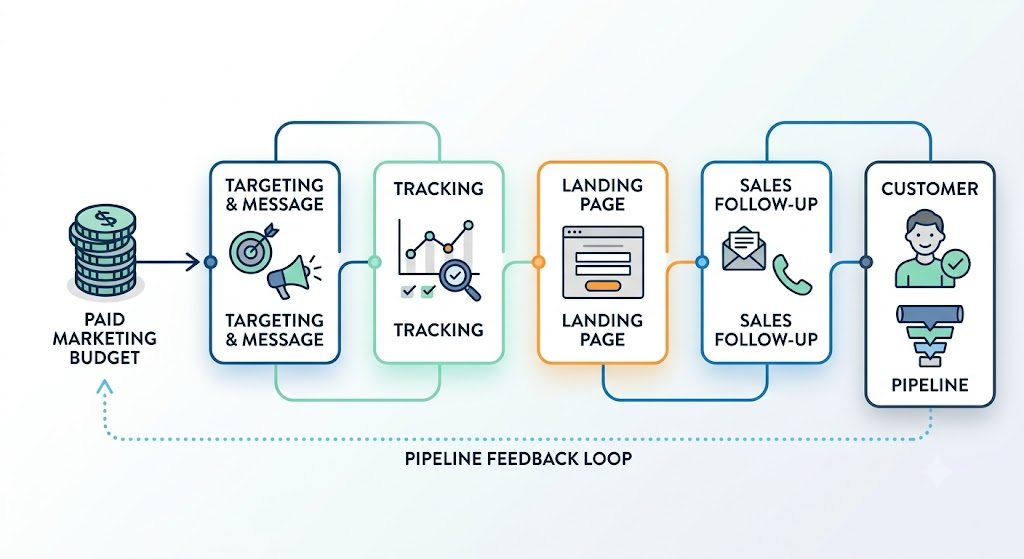
A bigger budget can help a working campaign scale.
It cannot turn a broken campaign into a healthy one by itself.
If tracking is broken, more budget gives you more unreliable data.
If targeting is loose, more budget buys more irrelevant attention.
If the landing page is confusing, more budget sends more people into confusion.
If the sales team is slow to follow up, more budget creates more missed opportunities.
This myth usually appears when pressure is high. The team needs more leads. The account is underperforming. The simplest lever is a pendulum.
But spending should not be the first fix.
Before increasing the budget, the account needs a basic health check.
Is conversion tracking accurate?
Are cold, warm, and branded audiences separated?
Are search terms clean?
Are negative keywords being reviewed?
Does the landing page match the ad?
Does the offer match the audience stage?
Are leads being contacted quickly?
If those answers are weak, the budget is not the solution. Budget is the amplifier.
It will amplify whatever is already happening.
If the system is clean, that is good news.
If the system is messy, more budget just makes the mess bigger.
Is retargeting just showing the same ad again?
Retargeting is often treated like repetition.
Someone visited the site, so the campaign shows them the same ad again and again.
That is better than ignoring warm traffic completely, but it is not the best use of retargeting.
Warm traffic has already shown some level of interest. The next message should move the conversation forward.
A person who visited your pricing page may need proof.
A person who reads a blog post may need a clearer problem statement.
A person who visited a service page may need a stronger offer.
A person who started a form but did not submit may need less friction or more trust.
Retargeting should not simply remind people that you exist. It should answer the question they probably have next.
That means different warm audiences should see different messages.
A homepage visitor and a pricing page visitor should not always be treated the same way. A guide downloader and a demo page visitor are not at the same stage. Someone who watched most of a video is warmer than someone who bounced after three seconds.
Good retargeting creates progression.
Bad retargeting just repeats itself until people stop noticing.
What should marketers believe instead?
The opposite of a marketing myth is not another catchy belief.
It is a better way to think.
Traffic is not the goal. Qualified demand is the goal.
Clicks are not the goal. The right people taking the right next step is the goal.
Leads are not the goal. Pipeline is the goal.
Automation is not the strategy. It is the engine that needs the right direction.
Budget is not the fix. It is the amplifier.
A platform is not good or bad in isolation. It is either matched or mismatched to your audience, offer, intent, and sales process.
This shift changes the way campaign reviews happen.
Instead of asking, “Did CPL go down?” ask, “Did qualified pipeline improve?”
Instead of asking, “Did we get more clicks?” ask, “Did we attract the right people?”
Instead of asking, “Should we spend more?” ask, “What would more spending amplify?”
Instead of asking, “Does this platform work?” ask, “What job are we asking this platform to do?”
These questions are not as exciting as big marketing opinions.
But they are much better for decision-making.
How do you stop these myths from hurting your own campaigns?
You do not kill marketing myths by debating them.
You kill them by checking the account.
Start with the basics.
Look at what the campaign is optimizing for. Check whether the conversion event is meaningful or just easy to track. Review whether the CRM receives source, medium, campaign, and lead quality data. Look at the search terms report. Check whether cold, warm, and branded traffic are separated. Compare the ad promise with the landing page headline. Review whether the CTA matches the buyer’s stage.
Then look at what happens after the lead comes in.
Does sales follow up quickly?
Do the leads match the ICP?
Are rejected leads being fed back into campaign decisions?
Does the team know which campaigns are creating pipeline, not just platform conversions?
This is where the real answers usually appear.
Paid campaigns do not only fail because of bad ads. They often fail because the team is acting on a belief that sounds right but does not match the data.
That is the real danger of these myths.
But once they start guiding spend, they can quietly turn a decent campaign into an expensive guessing game.
So before you scale, pause.
Ask what you are assuming.
Then check whether the account agrees.
That one habit can do more for your marketing results than another round of random campaign changes.